Across industries, boards are quietly bracing for a reset year in 2026 — one defined by AI integration, workforce re-skilling, and a reimagining of how performance is defined and rewarded.
We have reached a moment where technology, talent, and governance can no longer operate in silos. The forward-thinking boards I work with are not reacting to disruption — they are preparing for it by aligning strategy, compensation, and human capital in ways that not only protect shareholder value but also strengthen organizational resilience and purpose for the long term.
The companies that succeed over the next decade will be those whose boards embrace a more comprehensive approach to oversight — one that balances financial outcomes with capability building, ethical leadership, and a clear-eyed understanding of how AI is reshaping the workforce. Here’s how boards can start reframing their priorities now.
1. Redefining Performance and Compensation
Traditional compensation models — those tied solely to quarterly results and short-term financial outcomes — are losing relevance. In a world being reshaped by AI and continuous transformation, adaptability, learning velocity, and responsible innovation are the new performance currencies.
Boards must begin to reward leaders not just for what they deliver, but how they deliver it. Agility, ethical foresight, and a commitment to building capability across the enterprise are becoming as important as earnings growth.
This shift requires boards to evaluate leadership performance through a broader lens — one that captures behaviors, not just outcomes.
Future compensation frameworks will need to balance traditional financial metrics with measurable progress in transformation, culture, and workforce readiness. This is where many boards can benefit from expanding the KPIs they track. Examples include:
- Demonstrated progress in re-skilling and talent mobility
- Effectiveness in implementing AI responsibly
- Strength of leadership bench and readiness pipelines
- Measurable improvements in cross-functional collaboration
- Contribution to culture, trust, and engagement
If compensation remains grounded in short-term outcomes alone, organizations risk rewarding leaders for maintaining the familiar rather than championing the future. Boards that embrace multi-dimensional performance models will build a stronger bridge between today’s operations and tomorrow’s opportunities.
2. Rethinking Succession Beyond Names on a Chart
Succession planning used to be about identifying who is next in line. Today, it is about identifying who is ready to lead through volatility.
The pace of disruption — technological, regulatory, and cultural — requires successor candidates who can navigate dual realities: running the business of today while building the business of tomorrow. Boards must move beyond evaluating tenure and traditional career progression. Instead, they should assess readiness through dimensions such as:
- Leadership agility and learning mindset
- Digital fluency and understanding of AI-driven business models
- Experience leading transformation and building high-performing teams
- Ability to make ethical, transparent decisions under pressure
- Emotional intelligence, empathy, and communication effectiveness
The next generation of CEOs and executives must be capable of integrating technological disruption and cultural evolution — blending strategic vision with people-first leadership.
Boards that limit their focus to a slate of “high potentials” risk missing hidden stars deeper in the organization. Modern succession planning requires widening the aperture, using data and assessments to surface diverse talent and create personalized development plans that accelerate readiness.
When succession planning is too narrow, leadership gaps emerge precisely when organizations need courage, creativity, and foresight most. Broadening the definition of readiness will help boards future-proof leadership teams for whatever 2026 and beyond may bring.
3. Making Human Capital Oversight a Strategic Imperative
AI is reshaping jobs, skills, and organizational design faster than most governance models can adapt. Boards that still treat people strategy as an HR agenda item — rather than a strategic pillar — are already behind.
Human capital is not a cost center; it is a source of competitive advantage. Yet many boards receive limited visibility into workforce dynamics. Forward-looking boards are changing that by asking for:
- Workforce analytics tied directly to strategy
- Skills inventories and projected capability gaps
- Talent acquisition trends and productivity insights
- Culture and engagement data with clear ownership
- Ethical frameworks around AI deployment
- Plans for reskilling and internal mobility
This shift requires CHROs to bring more data, more insight, and more clarity into the boardroom — but it also requires boards to ask sharper questions.
The companies that thrive in 2026 will be those whose boards view human capital with the same rigor they apply to financial performance. Culture, skills, and workforce design are now determinant factors in value creation. They deserve strategic oversight, not periodic updates.
4. Balancing AI and Human Leadership
The board’s responsibility is not to champion AI for its own sake, but to ensure it enhances human capability rather than replaces it.
AI can accelerate performance, efficiency, and insight, but it cannot replicate trust, judgment, or empathy. Boards must protect that balance.
This requires governance frameworks that include:
- Data ethics and AI transparency guidelines
- Regular assessments of how AI impacts jobs and teams
- Clear communication to employees around AI-driven decisions
- Investment plans for reskilling and capability building
- Leadership development that helps executives manage blended human-AI environments
Boards should also ensure that leaders are equipped to use AI responsibly. This means ensuring leaders understand not only the technology’s capabilities but also its limitations. It also requires organizations to build cultures where people feel safe raising concerns, asking questions, and challenging decisions influenced by AI. Technology can speed progress, but only humans can sustain trust. Boards must guard that balance fiercely and set the tone that people, culture, and ethics remain at the center of decision-making.
5. The New Triangle of Influence: CHRO, CIO, and CEO
In 2026, the organizations that thrive will be those where the CHRO, CIO, and CEO operate as a unified triangle of influence.
The days of technology decisions happening in isolation from people strategy are over. AI adoption, automation, and digital transformation are fundamentally workforce issues — not just IT initiatives.
Boards need to encourage close partnership and alignment across these three roles. When the CHRO brings workforce insight, the CIO brings technology vision, and the CEO brings strategic alignment, decisions become more holistic, scalable, and sustainable.
This model closes the gap between strategy and execution. It ensures technology investments translate into capability building, and it strengthens an enterprise’s ability to innovate responsibly.
Boards can reinforce this dynamic by structuring meeting agendas that integrate human capital, technology strategy, and business performance rather than treating them as independent topics. When these functions operate cohesively, organizations move faster — and with greater clarity.
6. Culture and Purpose: The Invisible Metrics of Board Success
You cannot measure culture on a balance sheet — but every board knows when it is slipping. Culture and purpose are no longer “soft” concepts; they are critical governance indicators.
Boards must learn to treat culture as both a strategic asset and a measurable one. That means asking for:
- Leading indicators of culture health
- Patterns in engagement, turnover, and sentiment
- Signals of burnout, performance inconsistency, and friction
- Clarity around purpose and whether it’s reflected in decision-making
- Leadership behaviors that either strengthen or erode trust
Culture is shaped every day by what leaders choose to prioritize. It affects innovation, retention, customer experience, and risk. Boards that view culture as foundational — and that are willing to intervene early — will be the ones that sustain both performance and trust through the next cycle.
Purpose is the companion to culture. In an era of rapid change, employees and customers want to understand why an organization exists beyond profit. Boards cannot dictate purpose, but they can ensure it remains visible, lived, and aligned with strategy.
Looking Ahead
As 2026 approaches, the best boards are not waiting for disruption — they are preparing for reinvention. They recognize that AI, strategy, and human leadership are no longer separate conversations. The future of governance lies in integrating them — ensuring that technological progress amplifies, rather than erodes, the human side of business.
Because in the end, the measure of a great board won’t just be how it manages change — but how it enables people to thrive through it.
About the Author
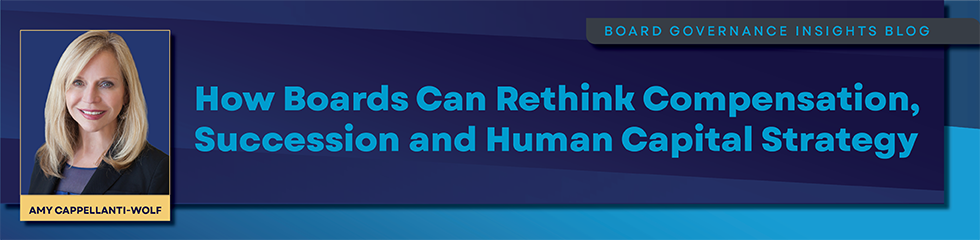
Amy Cappellanti-Wolf is the Chief People Officer at Dayforceand a recognized thought leader on organizational transformation, culture, and the future of work. She has held senior HR and business leadership roles at companies including Cisco, Disney, and Silver Spring Networks. Amy serves on multiple boards and is passionate about advancing human-centered leadership in the age of AI.






 Diversity, Equity, and Inclusion (DEI)