
The New Imperative: Board Refreshment for a Changing Landscape
The company boardroom was designed for a slower world. Today, artificial intelligence (AI) evolves weekly, cyber threats emerge daily, activist investors mobilize overnight, and reputational crises spread globally within hours. Yet many boards still operate with structures, expertise, and decision-making rhythms built for the last decade, not the next one. The gap between the speed of disruption and the speed of governance is widening, and many boards are unprepared. Governance cadence, composition, education, and culture may be mismatched to modern velocity.
The Governance Inflection Point
The average age of a board member means many are often 10 or more years removed from the active workforce, and their knowledge may be outdated. Furthermore, one-third of S&P 500 board directors are projected to reach retirement age in the next 5 to 7 years (Spencer Start, 2025). These retirements will create an inflection point and provide a lever for board refreshment.
Hidden Risk of Board Stagnation
The external pace of change is so rapid that internal decisions occur at a faster cadence than quarterly board meetings allow. In addition to cadence, the board culture may need refreshing. Some board directors believe that collegial cultures are better; however, some of the best-performing companies are now encouraging a more challenging culture (Bousquette, 2025). The greatest governance risk may no longer be poor oversight, but stagnant, outdated oversight. Refreshment is critical. This article will explore two areas of board refreshment that need to change more rapidly than they currently are to keep pace with the external environments: diversity and risk resilience, and AI education.
Risk Resilience
Board composition is no longer a symbolic governance issue; it is a strategic capability issue that must be optimized to govern effectively in increasingly complex environments. Board diversity is an important tool to build resilience by improving decision quality, reducing blind spots, and increasing cognitive variety. One of the most impactful changes to boards has been the recent de-emphasis on board diversity. In 2024, roughly half of all S&P 500 companies had a policy that considered gender, racial, and ethnic diversity in board director placement. In 2025, that number dropped to roughly 25%. In 2026, year-to-date, that number dropped further to roughly 14%.
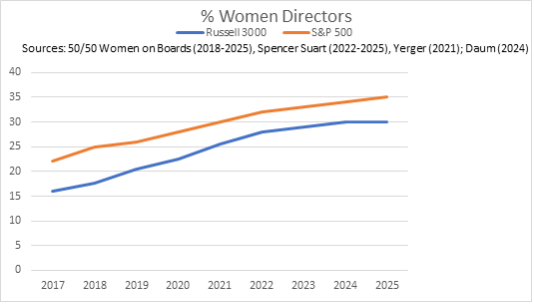
To understand how policy affects results, data from both the Russell 3000 and the S&P 500 were considered. The percentage of women directors was used as a proxy for overall diversity because historical data were consistently available. Figure 1 shows that the percentage of women directors steadily increased from 2017 until it plateaued in 2024. In 2024, we saw a decline in policies, including the NASDAQ Board Disclosure Rule and the Securities and Exchange Commission’s (SEC) withdrawal of ESG disclosure initiatives. As a result, we are now seeing companies adding women and minority directors at the same pace as ten years ago (Francis, 2026), indicating a backslide in progress. Most leaders publicly agree that diverse boards improve decision quality by reducing groupthink, broadening pattern recognition, and increasing the range of strategic perspectives in times of uncertainty. Yet growth seems to be stagnating in the absence of regulatory pressure.
Stagnating progress toward board diversity is making boards and the companies they govern vulnerable to threats and weaknesses that often arise from like-thinking. Board turnover can offer opportunities to improve board diversity and, in turn, increase risk resilience.
AI Changes the Governance Equation
AI is not simply another technology trend; at many companies, it is a structural shift redefining competition, risk, labor, and decision-making. Many experts are discussing AI extensively, yet few seem to fully understand its tactical implications in practice. While the full implications remain uncertain, the scale of disruption is already undeniable. Using and incorporating generative AI is foundational to the future. Companies that fail to keep pace with change are headed toward difficult times. (Bousquette, 2025).
The three legs of AI programs should be considered when assessing AI impacts: risk and governance, efficiencies, and innovations. The SEC recently recommended that both the use and oversight of AI be disclosed (Wenger & Lewis, 2026). Best practices for the use and disclosure are still evolving, and most board directors are nowhere near understanding potential implications. Without intentional focus, the likelihood of missed efficiencies and opportunities is high. Most boards are not prepared to guide during these vulnerable, turbulent, and uncertain times in technology and have a responsibility to learn more collectively. I imagine that we have all seen our own boards’ opinions about AI swing. Many learn about it in bite-sized pieces, opining without full understanding. They are expected to oversee AI strategy without ever having worked in AI-enabled operating environments themselves. Governing something that you do not understand is a near-impossible ask.
The Future Ready Board
As we see the roles and responsibilities of board directors evolving, we must prioritize board refreshment. In doing so, we can ask questions that challenge the status quo and enable rapid, thorough vetting of complex issues. Some critical questions to consider for collaborative conversations include:
Are boards, as they are structured today, relevant to corporate success?
What structural changes should we be making today to ensure more resilient and equitable outcomes?
How do we select and educate board directors?
Can we improve the process by which boards make decisions?
How can we optimize board composition for better outcomes?
These types of questions can lead to simple actions that boards can take today. Some of these actions might include mandatory continuing education, AI fluency expectations, shorter board tenures, competency-based director matrices, faster governance cadence, and periodic board capability audits. Board refreshment often follows a slower turnover cycle, and working within its natural flow is important. However, Board Chairs, Committee Chairs, CEOs, and education and certification organizations can take early steps to promote more immediate conversations and actions.