
Member Advisory: Director Alert on Recruiting & Impersonation Scams
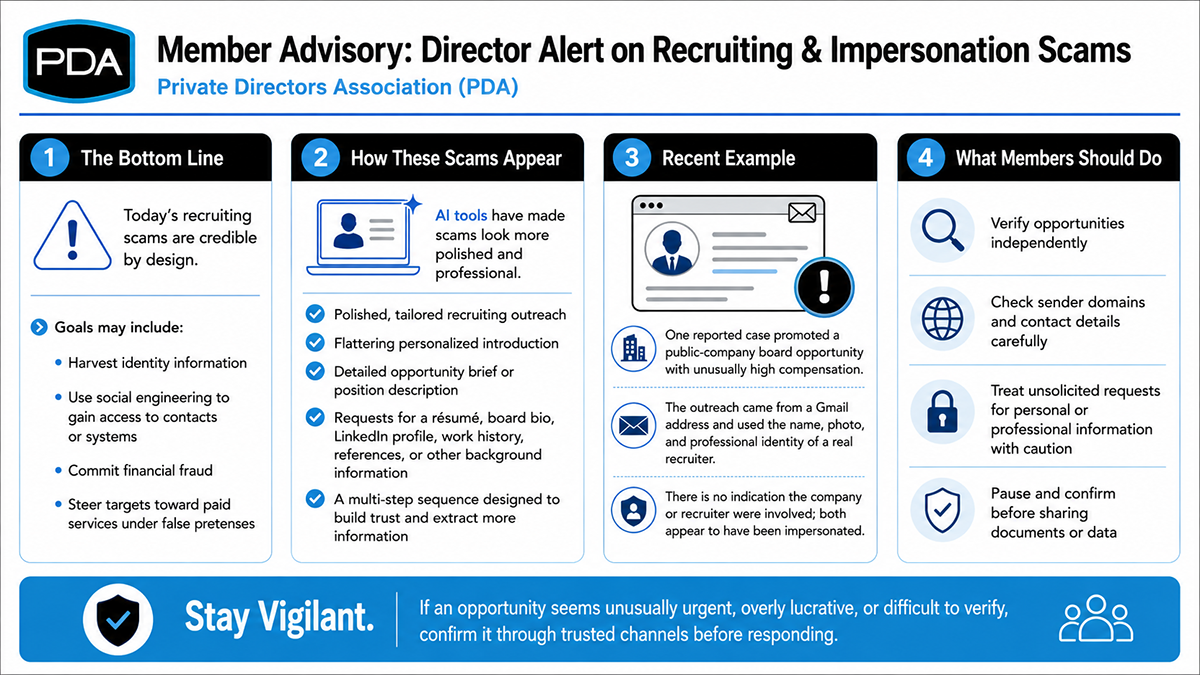
Private Directors Association (PDA) is alerting members to a growing wave of sophisticated recruiting and impersonation scams targeting directors and governance professionals. These schemes are designed to look credible—often presenting as board seats, executive roles, advisory or consulting engagements, and even speaking invitations—any opportunity significant enough to earn immediate attention.
The Bottom Line
Today’s recruiting scams are credible by design. The true intent is rarely obvious at the outset. In many cases, the goal is to:
- Harvest personal identity information
- Conduct social engineering to gain access to additional contacts or systems
- Commit financial fraud
- Steer targets toward paid services under false pretenses
What follows is one example of an evolving pattern PDA members should be prepared to recognize early.
How These Scams Typically Appear
Members should be cautious of outreach that arrives as a polished, tailored recruiting sequence—often written well enough to bypass traditional “red flag” filters. Artificial intelligence has reduced the poor grammar and formatting that once made these attempts easier to spot.
These scams frequently unfold over multiple emails, such as:
- A flattering, personalized introduction
- A detailed “opportunity brief” or position description
- A request for a résumé, board bio, LinkedIn profile, work history, references, or other background information
Each step is engineered to build trust and extract more information.
A Recent Example
In one recent instance shared with PDA, the scam presented a public-company board opportunity tied to Teladoc Health, Inc. (NYSE: TDOC)—including a director and risk committee leadership seat and compensation described as significantly higher than what the role would typically offer.
The outreach originated from a Gmail address and used the name, photograph, and professional identity of a real recruiter with an established LinkedIn presence. The recruiter’s photo was included in the email signature to reinforce legitimacy.
PDA emphasizes that there is no indication Teladoc Health or the recruiter whose identity was used had any involvement. Both appear to be victims of impersonation.
Why PDA Is Sharing This
This advisory is being shared not because the attempt was unusual, but because it was convincing—and the next one may be even more so. Members are encouraged to remain vigilant, verify opportunities independently, and treat unsolicited requests for personal or professional background information with caution, even when the outreach appears polished and credible.